
Outsourced Print Fulfillment vs. In-House Fulfillment · Which Is Better for Your Business?
Written by Jamie Cloak, Director of Sales & Marketing at Omega High-Impact Print Solutions
When your business regularly needs printed marketing materials, managing production, storage, and distribution can become a job of its own. You need to keep materials organized, monitor inventory, coordinate shipments, and make sure the right items reach the right locations at the right time.
For some businesses, handling these tasks internally makes sense. For others, outsourcing print fulfillment to a commercial printing partner can save time, free up space, and simplify day-to-day operations. The right choice depends on your print volume, available resources, distribution needs, and how often your materials need to be updated or replenished. Here's how the two approaches compare and what to consider before deciding.

What Is the Difference Between Print Fulfillment and In-House Fulfillment?
In-house fulfillment means your business manages its own printed materials after production. This typically includes receiving printed products, storing inventory, preparing orders, packing materials, and coordinating shipping or distribution. Print fulfillment combines printing with some or all of these downstream services. Depending on the provider, your printed materials can be produced, stored, assembled into kits, and shipped as needed.
The main difference is who manages the process and what resources your business needs to provide.
In-house fulfillment | Outsourced print fulfillment |
Your team manages inventory and distribution | A fulfillment partner manages agreed-upon services |
Requires internal space and resources | Can reduce the need for dedicated storage and labor |
Your team coordinates production and shipping | Printing and fulfillment can be coordinated through one provider |
You control day-to-day processes directly | Processes depend on your provider's systems and service agreement |
Capacity depends on your internal resources | Capacity depends on the provider's capabilities and available space |
Neither option is automatically better. The goal is to choose an approach that fits your business without creating unnecessary work or expense.
How Does Print Fulfillment Work?
Print fulfillment connects printing with the storage and distribution of finished materials. Instead of receiving an entire print order and managing everything yourself, you can arrange for materials to be held in inventory and shipped as needed.
A typical print fulfillment process includes:
Printing and production: Materials such as brochures, catalogs, business forms, signage, and promotional pieces are produced according to your specifications.
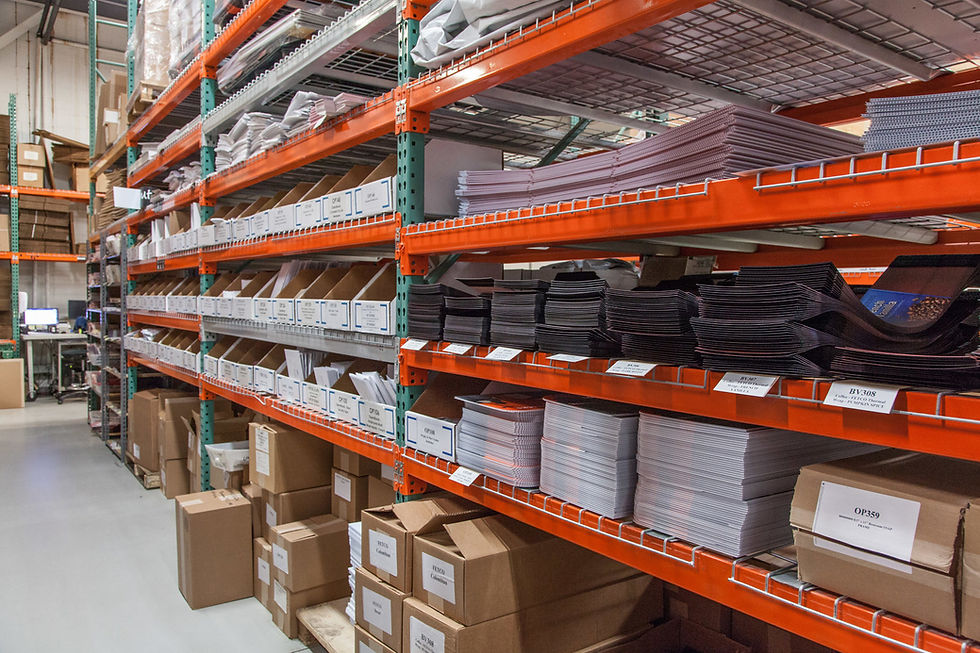
Warehousing and inventory management: Finished materials are stored until they're needed.
Kitting and assembly: Multiple printed items can be grouped into packages or kits for specific locations, campaigns, employees, or customers.
Order processing: Materials are prepared according to your distribution requirements.
Shipping and distribution: Orders are shipped to individual locations, offices, distribution points, or recipients as needed.
The exact services available vary by provider. Before choosing a partner, confirm how inventory is tracked, how orders are submitted, and how shipping and handling costs are calculated. For businesses with recurring print needs, this approach can create a more organized process for managing materials over time.
What Does It Cost to Manage Fulfillment In-House?
Managing fulfillment internally involves more than the cost of the printed materials themselves. Your business also needs to account for the resources required to receive, store, organize, prepare, and distribute those materials.
Common expenses include:
Storage space: Warehouse space, shelving, storage equipment, and related facility costs.
Labor: Employee time spent receiving inventory, tracking materials, packing orders, and coordinating shipments.
Packing supplies: Boxes, labels, protective materials, and other shipping supplies.
Shipping and handling: Carrier charges, package preparation, and distribution costs.
Inventory management: Systems and processes for tracking quantities, monitoring usage, and identifying when materials need to be reordered.
Waste and obsolescence: Printed materials that become outdated after a campaign, product, or brand update.
Some of these expenses may already be part of your normal operations. If your business has available warehouse space and employees who can manage fulfillment efficiently, the incremental cost of handling it internally may be relatively low. However, if fulfillment regularly pulls employees away from their primary responsibilities or requires additional space and staffing, outsourcing may be worth evaluating.
To make a meaningful comparison, calculate the full cost of your current process rather than looking at shipping expenses or warehouse costs in isolation. Then compare that total with a fulfillment provider's pricing, including storage, handling, and any applicable setup or order fees.
When Should a Business Outsource Print Fulfillment?
Outsourcing becomes worth considering when managing printed materials internally creates more work, expense, or complexity than your business wants to handle.
Here are several situations where print fulfillment may be a better fit:
You Have Limited Storage Space
Printed materials can take up surprising amounts of space, especially when you order in bulk to meet pricing or production requirements. A fulfillment partner can store materials in a dedicated warehouse, leaving your own facility available for daily operations. This can be especially useful for businesses that distribute brochures, catalogs, promotional materials, signage, or other products throughout the year.
You Ship Materials to Multiple Locations
If your business operates across multiple offices, retail stores, franchises, or regional facilities, distributing printed materials can become complicated. A print fulfillment partner can help coordinate shipments to different destinations according to your requirements. This may include preparing location-specific kits, dividing materials by destination, and arranging recurring shipments. For organizations with many locations, a defined fulfillment process can help reduce the administrative burden on internal teams.
You Have Recurring Campaigns or Print Orders
Businesses that regularly distribute marketing materials may benefit from keeping commonly used items in inventory.
Rather than arranging a new print run and managing every shipment separately, you can establish a process for replenishing materials and shipping them when needed. This can help simplify recurring campaigns, seasonal promotions, and ongoing sales support. Inventory levels and reorder points should be planned carefully so materials remain available without tying up too much money in excess stock.
Your Team Is Spending Too Much Time on Logistics
Your employees have other responsibilities. If they're routinely counting inventory, assembling packages, coordinating deliveries, or searching for materials, fulfillment may be taking time away from higher-priority work. Outsourcing can shift some of those responsibilities to a partner that already has the space, equipment, and processes to manage them. The benefit isn't simply reducing the number of tasks on your team's list. It's making better use of the people and resources you already have.
You Need Printing and Fulfillment to Work Together
Using separate vendors for printing, storage, assembly, and shipping can create additional coordination between providers. A commercial printer that also offers fulfillment can connect more of these steps under one relationship. Depending on the provider, that can simplify communication, production planning, and inventory replenishment.
Is Print Fulfillment a Good Fit for Multi-Location Businesses?
For businesses operating across multiple locations, print fulfillment can help centralize the management of marketing and operational materials. Consider a company with 25 locations that needs updated brochures, promotional signage, forms, and branded materials throughout the year. Without a coordinated process, individual locations may need to request materials separately, maintain their own supplies, and track deliveries. This can make it harder to maintain consistent inventory and ensure everyone is using the correct materials.
With a centralized print fulfillment program, the company can coordinate production and inventory in one place, then distribute materials according to each location's needs.
A program may include:
Standardized printed materials for all locations.
Location-specific versions of brochures, signage, or promotional pieces.
Preassembled kits for new openings, seasonal campaigns, or promotions.
Inventory tracking and replenishment planning.
Scheduled or on-demand shipments to designated destinations.
Centralization doesn't mean every location needs the same materials or receives them at the same time. A well-planned program accounts for differences in location, timing, and demand while keeping the overall process organized.
For national brands, franchise systems, retailers, and organizations with distributed teams, these considerations can be just as important as the printing itself.
What Should You Look for in a Print Fulfillment Partner?
Not all commercial printers offer the same fulfillment services. Before choosing a provider, evaluate how well its capabilities align with your actual needs.
Printing capabilities: Can the provider produce the types of materials you use regularly? Working with a partner that understands your print requirements can simplify production planning.
Warehouse capacity: Does the provider have sufficient space for your inventory, including seasonal increases or larger orders?
Inventory visibility: How will you know what's in stock, what has shipped, and when materials need to be replenished? Ask about the reporting and tracking processes available.
Kitting and assembly: Can the provider combine multiple items into packages for specific locations, campaigns, or recipients?
Shipping coverage: Can the provider support your distribution footprint and shipping requirements?
Communication and accountability: Who will be your point of contact? How are order requests, changes, inventory questions, and shipping issues handled?
Scalability: Can the process accommodate additional locations, new campaigns, or changes in order volume as your business grows?
It's also important to understand pricing. Ask for a breakdown of production, storage, handling, kitting, and shipping costs so you can compare providers accurately. The best partner is one that fits your workflow, provides the services you need, and establishes clear expectations for how the process will run.
How to Decide Which Approach Is Right for Your Business
Before making a decision, review your current fulfillment process and ask a few questions:
How much time does your team spend managing printed materials each month?
How much space does your inventory occupy?
How frequently do you need to ship materials, and to how many destinations?
Are your print needs predictable, or do they fluctuate throughout the year?
Are outdated materials or excess inventory creating waste?
Would consolidating printing, storage, and distribution simplify your operations?
If your print volume is low, your storage space is readily available, and your team can manage orders efficiently, in-house fulfillment may be the most practical option. If you regularly manage large quantities of printed materials, distribute items to multiple locations, or spend significant time coordinating inventory and shipments, outsourcing may offer a more efficient approach.
You can also consider a hybrid model. For example, your business might handle small, immediate orders internally while outsourcing bulk storage, kitting, and recurring distribution. The right arrangement doesn't have to be all or nothing.
Simplify Your Print and Fulfillment Process With Omega
Managing printed materials involves more than getting a finished product off the press. Storage, inventory, assembly, and distribution all play a role in getting those materials where they need to go. Omega High-Impact Print Solutions works with businesses to support print production and fulfillment needs, including warehousing, kitting, and shipping. With facilities in New Jersey, Florida, and Kentucky, Omega offers capabilities to help businesses coordinate print projects and manage the distribution of materials.
Whether you need printed marketing materials stored between campaigns, kits assembled for multiple locations, or a more organized approach to ongoing print distribution, the first step is understanding your requirements and finding a process that works for your business.
Looking for a better way to manage your printed materials? Contact Omega to discuss your printing and fulfillment needs.
Frequently Asked Questions
What is print fulfillment?
Print fulfillment is the process of managing printed materials beyond production. Depending on the provider, services may include warehousing, inventory management, kitting, order processing, packing, and shipping.
Is it cheaper to outsource print fulfillment?
It depends on your order volume, storage needs, labor costs, shipping requirements, and the provider's fees. Compare the full cost of managing fulfillment internally with the total cost of outsourced services before deciding.
Can a commercial printer store materials between orders?
Yes. Some commercial printers offer warehousing and inventory management services that allow businesses to store printed materials and request shipments as needed. Available storage and ordering options vary by provider.
Can print fulfillment support multiple business locations?
Yes. Print fulfillment can support distribution to multiple offices, retail stores, franchises, and other destinations. Services may include location-specific kits, scheduled shipments, and centralized inventory management.
What types of materials can be included in print fulfillment?
Depending on the provider's capabilities, materials may include brochures, catalogs, flyers, forms, promotional pieces, signage, and other printed marketing or operational products.
What is the difference between print fulfillment and traditional fulfillment?
Print fulfillment focuses on printed products and often connects printing with storage and distribution. Traditional fulfillment can cover a broader range of products and may not include print production. Some providers offer both types of services.
Can a business outsource only part of its fulfillment process?
Yes. Some businesses outsource select services, such as warehousing, kitting, or shipping, while managing other activities internally. The available options depend on the provider and the business's requirements.


Comments